

 Request
a Survey
Request
a Survey Request a Brochure
 Request a Call-Back
School canopy finance, planning and compliance: the complete guide
Posted on | Posted in Education, Helpful Guides, School Grants
Schools throughout the UK are finding that the right canopy can transform unused outdoor areas into useful spaces all year round. Whether you want to reduce pressure on dining areas, create outdoor classrooms for any weather, or give students better shelter when moving between buildings, this guide explains how to go from idea to installation.
Finance, planning and compliance tend to be the parts of the canopy process that school leaders worry about the most. We’ve broken down each area into simple terms to show you what’s actually involved.
Request a free site survey or explore payment plans
Contents
School canopy funding

Your funding options at a glance
Most schools fund canopy projects through one of four routes, or combine them to make up the full amount.
- Annual budgets and internal capital are often the first places schools look. When you’re making the case for a canopy internally, calculate the cost per square metre compared to a traditional building extension. Canopies usually come out as better value than an extension, especially when you factor in how quickly they can be installed.
- Finance leasing has become much simpler for schools recently. Since September 2024, you can arrange finance leases directly with providers without getting Secretary of State approval. You spread the cost across manageable payments, get the space straight away and own the canopy outright when the lease ends.
- External school grants are a great way to help bridge any funding gaps. There are various government bodies, charitable trusts and corporate community schemes that support school building improvements.
- PTA and community fundraising brings your school community together to help support a shared goal. We know schools that have raised thousands through well-organised fundraising campaigns, and there’s usually plenty of fun to be had along the way too.
School grants for outdoor projects
Grants can be used for school canopy funding in cases where the internal budget might not cover the cost. Grant programmes change regularly, so treat these as examples rather than a definitive list. Always carefully check the current application windows and criteria directly before applying.
National Lottery Awards for All
National Lottery Awards for All is a grants scheme that funds small, local community-based projects throughout the UK. Canopies are eligible if the space is used for community activities outside of school hours, such as a local sports club, a community garden or weekend events.
Condition Improvement Fund
The Condition Improvement Fund is a government-provided capital funding programme that supports academies and sixth-form colleges with work that keeps buildings safe and functional. Canopies that improve facilities or address building condition issues could qualify.
Sport England
Sport England offers grant programmes to support physical activity and improve community spaces. Funding is available for improvements that increase sports participation, so a canopy covering a games area or outdoor exercise space could be eligible.
Tesco Stronger Starts
Tesco Stronger Starts offers grants for schools and community organisations that support children and young people. Priority is given to projects that provide food and support, like breakfast clubs, equipment for indoor and outdoor activities or food-growing areas.
You can find more about grants, as well as guidance on applying for funding, on our school grants page.
Practical fundraising ideas for schools

Taking fundraising into your own hands is a great way to secure funds for resources and renovations you don’t have the budget for. We’ve worked with schools that have raised money to pay for part, or all, of their canopy through fundraising.
Getting kids, parents, staff and the community together is a great experience, and you might be surprised at how much you can raise when everyone gets involved.
Top tips for successful fundraising:
Make sure everyone involved knows what the cause is and where the money is going. Set a clear fundraising target and start thinking of some ideas to raise the money – remember, you may need a few different events to reach your goal.
- Set a clear target so people know what they’re working towards
- Promote widely through school newsletters and social media
- Show the impact – mock-ups or photos of similar projects help people see what their contributions go towards
- Celebrate progress along the way to keep momentum going
Here are some fundraising ideas for schools that you can try:
Quick wins for any time of year:
- Non-uniform days with a small donation required – these work great at the end of term
- Bake sales – quick and easy for raising smaller amounts regularly
- Raffles and competitions with prizes donated by local businesses
- Fun fancy dress days with themes that get everyone excited
- A ticketed musical performance or gig with family and friends of the school invited
- A football tournament with donation buckets on the day
- Sponsored litter picking in your local area
Seasonal fundraising opportunities:
- Autumn fairs with stalls, games and refreshments
- Bonfire Night events that tie into the season
- Christmas markets where families can buy gifts and festive treats
- Summer sports days with sponsored events and activities
Community-focused ideas:
- Local business sponsorship – many businesses are happy to support schools in their area
- Alumni appeals, particularly from schools with established former student networks
- Crowdfunding campaigns that can be promoted online to boost reach and support
- Sponsored challenges like family fun runs, sponsored swims (you could even tackle a distance like the English Channel spread over different groups), or sponsored hikes
Finance leasing made simple for schools

If you want to upgrade your school’s outdoor space but you’re concerned about budget, changes to school finance leasing have made it easier than ever. Since September 2024, UK schools and academies can arrange finance leases without having to get approval from the Secretary of State. This means your plans to create the perfect outdoor dining or learning space could become a reality sooner than you think.
Why leasing suits canopy projects
Finance leasing works particularly well for canopy projects because it allows you to spread the cost across an agreed period while giving you immediate use of the space. Rather than waiting until full funding is in place (something that used to stop many projects from going ahead) you can move forward straight away.
The benefits are practical and budget friendly.
- Predictable payments fit naturally with how schools plan and budget across the year
- You can finance 100% of the project cost, meaning there’s no need to part-fund from your existing budget
- Flexible terms let you choose repayments that work around your budget cycle
- You get immediate use of the space without having to wait for next year’s budget allocation
- You’ll have full ownership of the canopy at the end of the lease term
What to expect from Canopies UK
We’ve chosen our finance packages to be practical and straightforward. They cover the design, manufacture and installation of your canopy, with transparent leasing terms that are made to work with school budgets rather than against them.
The process is simpler than you might think. There’s no complicated case-building for Secretary of State approval and you don’t need to wait for budget committees to sign things off. We offer market-leading interest rates and flexibility on term lengths to make the option of finance leasing work for as many schools as possible.
Find out more about the changes from Jonathan Eastwood, Finance Director at Canopies UK: School canopy finance made simple: what’s changed one year on
Planning permission for school canopies
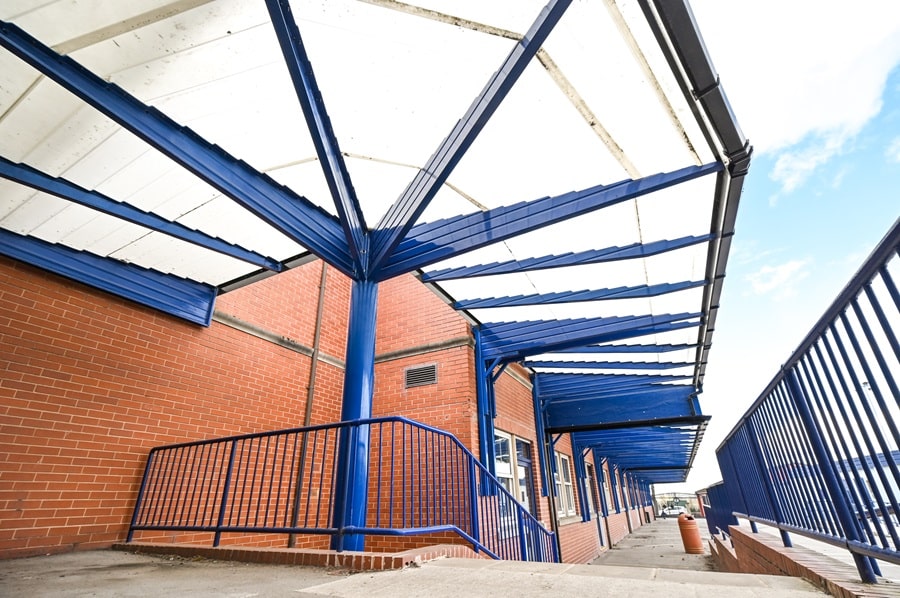
Many school leaders worry that planning permission will be a lengthy, complicated process. In reality, most school canopies fall under permitted development rights, which means you won’t need to submit a full planning application. That said, it’s important to understand the rules and when you do need to seek approval.
Do you need planning permission for a school canopy?
School canopies are categorised as building extensions under the Town and Country Planning legislation. In many cases, you won’t need planning permission if your canopy falls under permitted development rights. However, it ultimately depends on specific criteria, so we’d always recommend checking with your Local Planning Authority (LPA) before going ahead with installation.
Schools, colleges and universities are covered by Class M of the Town and Country Planning (General Permitted Development) (England) Order (GPDO). This means your canopy could be considered permitted development if it meets certain criteria, though there are important caveats to be aware of.
Permitted development limits for schools
Your canopy is more likely to qualify as permitted development if it meets the following criteria.
- Size limits mean the floor space of any buildings erected, extended or altered must be under 25% of the floor space of the original building, or under 100 square metres (whichever is lesser)
- The development should be at least five metres from the boundary of the school grounds
- The height of any new building must be under five metres
- If the land is used as a playing field, or has been in the past five years, the development can’t prevent it from being used in that way in the future
- The development needs to be within the curtilage of your existing buildings and used as part of activities associated with your school
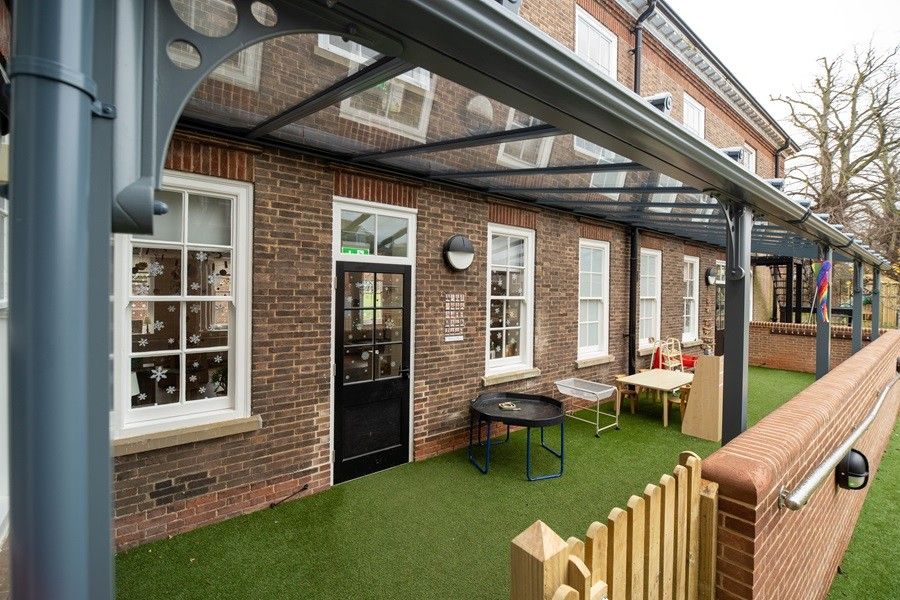
Permitted development rights don’t apply in certain circumstances. If your school is a listed building, in a conservation area or situated in a green belt, you’ll need to consult your Local Planning Authority before going ahead. That’s because these areas have extra rules in place to help protect their character and surroundings.
If planning permission is required
If your project doesn’t qualify for permitted development, you’ll need to submit a planning application. An application is made to the local council. Most councils handle planning applications digitally, and there will be an online portal for you to complete your application.
Here’s what that typically involves:
Documents you’ll need:
- Location and site plans showing where the canopy will be located
- Detailed canopy drawings with dimensions and specifications
- Information about materials and finishes
- A clear explanation of how the space will be used
How long does the application take?
Most standard planning applications take 8-12 weeks for a decision, though this can vary depending on your local authority and the complexity of the project. If your school building is listed or in a green belt area, the timelines could be longer. Your LPA will send you a formal notice or email which states the target date for their decision.
Does planning permission cause lengthy delays?
No, planning permission will rarely hold up your new canopy installation. We account for the time to seek planning within our design and production timescales. You will know the installation dates to work towards after the initial discussions with us.
Will Canopies UK help with the process?
At Canopies UK, we’ve worked with many schools through the planning process. We’re happy to guide you through what’s required and can provide a 2D CAD drawing and artist’s impression for your application. Please note that we do not provide elevation drawings.
If you’re unsure whether you need planning permission, we can discuss your specific site during a free site survey.
Get started: request your free site survey today
Compliance and best practice
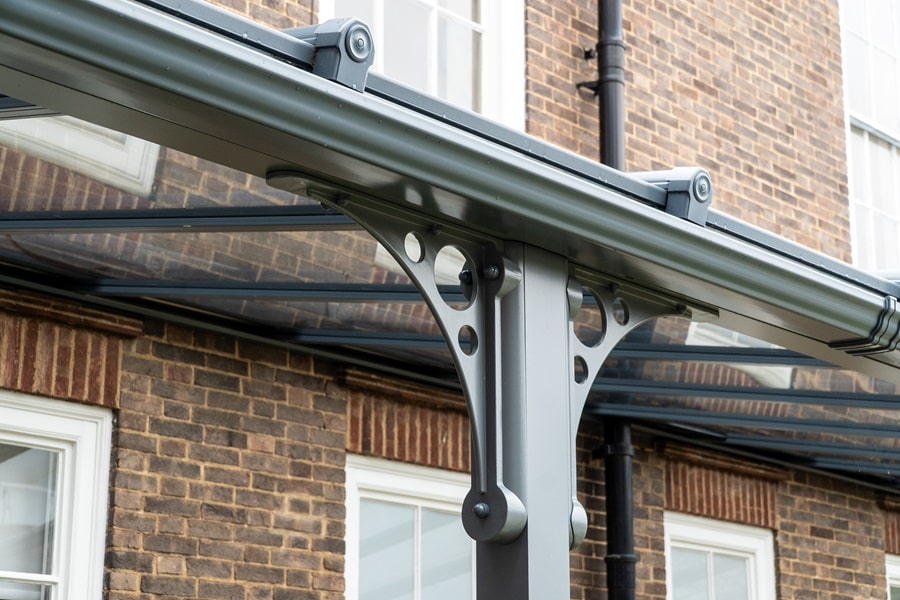
Getting the technical aspects right means creating a space that’s fit for purpose for years to come.
Safety and structural assurance
Every school site is different, which is why site-specific calculations are so important. These assessments look at local wind patterns, snow loads, ground conditions and drainage requirements to ensure your canopy will perform safely in your specific location.
While some companies charge extra for these calculations, we include them as standard in every project. They’re fundamental to getting the right canopy and we don’t think schools should pay more for something essential to safety and longevity.
What you should expect:
- Calculations that comply with Eurocodes, including BS EN 1991-1-3 for snow loads and BS EN 1991-1-4 for wind loads
- Quality materials that stand up to British weather conditions
- UV-protective roofing that filters harmful rays while allowing natural light through
- Warranties that back your investment for years to come
Read more about our site-specific calculations process and the guarantees we offer.
Working safely on school sites
School environments need extra care during installation. We know safeguarding is crucial, which is why all our installers are employed directly by us and undergo thorough Disclosure and Barring Service (DBS) checks. Every member of our team meets the highest standards of professionalism.
We’ve completed many term-time installations over the years too, so our process is well-honed and designed to minimise disruption. We offer:
- Secured work zones with fenced off areas to keep children safe
- Coordinated deliveries at a time that’s convenient to you, outside busy periods
- Nominated lead installer who acts as your main point of contact
- Construction Phase Plans (CPP) and Risk and Method Statements (RAMS)
- Efficient installation timelines – typically within 2-5 days
Accessibility and inclusion
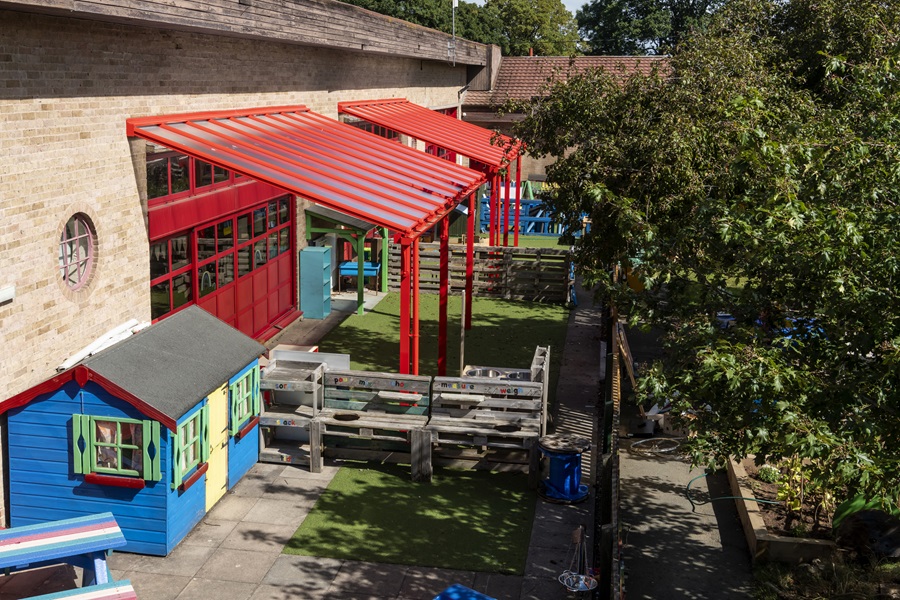
A well-designed canopy should be accessible to everyone in your school community. Think about:
- Clear, wide routes that accommodate wheelchair users and those with mobility aids
- Appropriate lighting for use during darker months and evening events
- Level surfaces or gentle ramps where needed
- Layouts that allow easy movement during busy periods like lunchtimes
Learn more: How schools can design inclusive outdoor spaces
Maintenance
One of the main advantages of a quality canopy is that they’re very low maintenance, with minimal upkeep needed to keep them looking their best. However, it’s still worth establishing a simple plan.
- Cleaning schedule: A periodic clean of the roofing panels keeps them looking good and performing well
- Visual checks: A quick inspection after severe weather helps you spot any issues early
- Annual checks: A simple inspection check once a year ensures everything remains in good condition
- Drainage: Keep gutters and drainage points clear of leaves and debris
Most schools find this quickly becomes part of a routine and takes very little time, especially compared to maintaining traditional building extensions.
Choosing the right canopy
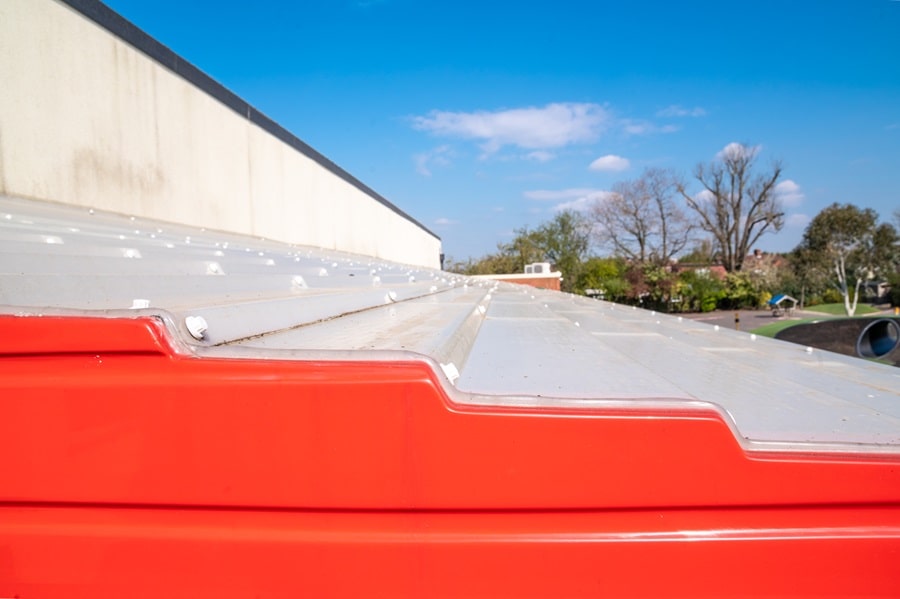
There’s no one-size-fits-all when it comes to school canopies – different canopies suit different spaces, so you should always find the right style for your site. Here are the main options and what they’re best suited for:
Matching the canopy to your needs
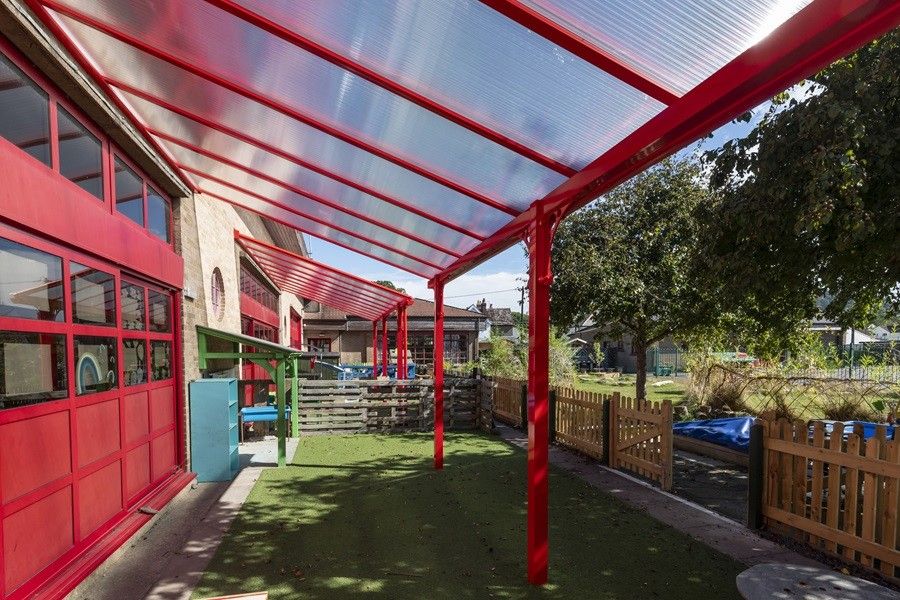
Outdoor classrooms give schools extra space for lessons in the fresh air all year round. Modern systems like our Connekt range are modular and adaptable, which means they can grow with your needs.
Whether you start with a smaller area and expand later or know exactly what size you need from day one, modular systems give you flexibility to make the space work for you. They can be freestanding or fixed to existing buildings, depending on your site setup.
Space and comfort are key at lunchtimes. Dining canopies are designed for capacity, with wider spans to fit tables easily and keep students moving freely.
The most advanced systems, like our Cantabria with its retractable roof, heating and lighting, effectively give you an additional room rather than just a covered space. This means the area can be used comfortably throughout the school year, not just in good weather.
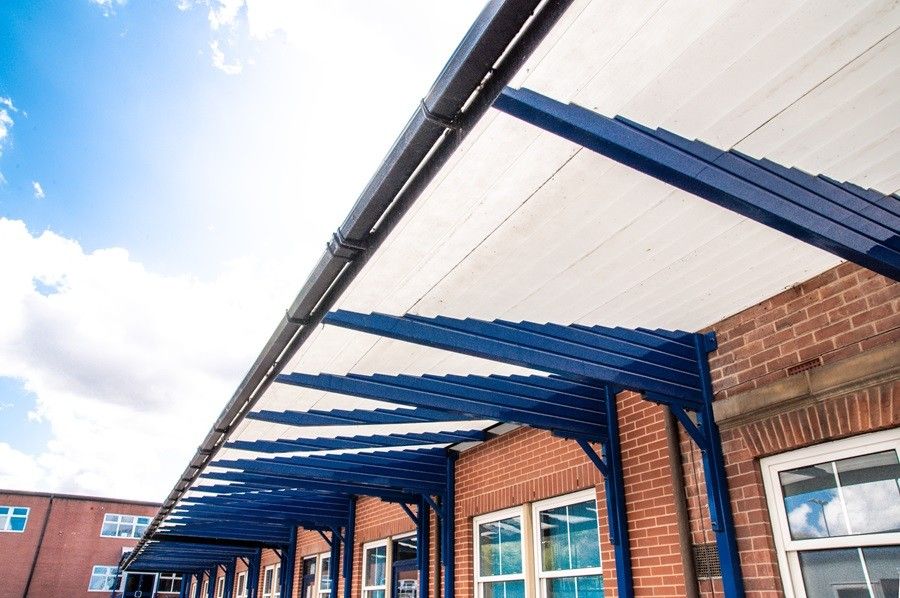
Covered walkways keep students and teachers dry and make moving between buildings simpler in all weathers.
Whether you choose a freestanding or wall-mounted version depends on your site layout and buildings. Self-supporting systems like Olympus work well where wall mounting isn’t possible, and can be placed in open areas, while wall-mounted options can create unobstructed all-weather routes between buildings.
Design considerations
Once you’ve chosen a canopy system, it’s worth thinking about how the space will be used day-to-day.
Span and coverage
How much space do you actually need? Think about your busiest times of day. A dining canopy needs to comfortably fit students during your busiest lunch sitting, while a covered walkway should be wide enough for pupils to easily pass each other during lesson changeovers.
Enclosure options
Would side panels help with wind or rain, or would an open canopy design suit your site better? Some schools start with an open structure and add more panels later, once they know how the space is used.
Colours
Most modern canopies can be colour-matched to your school buildings. It’s a small detail that helps the structure look like it’s always been part of the site.
Future flexibility
If your needs might change, modular systems are easier to extend or reconfigure than fixed structures, so you have room to adapt without starting from scratch.
Talk to our school canopy specialists to discuss what would work best for your school
Step by step: from survey to installation

Understanding how the process works helps you plan ahead and know exactly what to expect.
Free site survey and proposal
It all begins with a visit to your school. Our surveyors take careful measurements, check the ground conditions and talk through what you want to achieve. It’s a chance to ask questions and explore what’s possible for your site.
After the visit, you’ll receive a proposal that includes:
- The recommended canopy system and specifications
- Information on site-specific calculations
- Clear pricing with no hidden extras
- An estimated project timeline
There’s no obligation at this stage. The survey and proposal are completely free, giving you everything you need to make an informed decision.
Free download: What to expect from Canopies UK’s site survey process
Preparation and planning
Once you’re ready to move forward, we handle the technical details while keeping you involved in the practical planning.
- Design finalisation: We’ll confirm the exact specifications, colours and any custom features so you know exactly what’s being built
- Planning and approvals: If your project needs planning permission, we can provide the drawings and technical information for your application
- Funding arrangements: If you’re using finance leasing, we can guide you through the process
- Scheduling: We’ll work with you to agree installation dates that fit around the school calendar, whether that’s during holidays or term time.
Installation and handover
When installation day arrives, you’ll meet a team who understands the school environment and how to work safely within it.
- Professional installation: Our installers set clear boundaries around the work area to keep staff, visitors and students safe
- Consistent communication: You’ll have a nominated lead installer who keeps you updated throughout the installation
- Efficient turnaround: Most projects take between two and five days, depending on the size and site conditions
- Safety and sign-off: Before handover, we carry out a final inspection to make sure the canopy meets all quality and safety standards
- Warranties and aftercare: Your warranty – typically five or ten years depending on the system – starts from handover, and our team is always on hand for aftercare and advice if needed
Frequently asked questions
Do we need planning permission for a school canopy?
In most cases, no. School canopies usually fall under permitted development rights, meaning you don’t need planning permission if the structure stays within certain size and height limits. We’ll confirm this during your site survey. If your school is listed, in a conservation area or on green belt land, you should check with your local planning authority before going ahead.
What are the permitted development limits for schools?
Class M of the General Permitted Development Order applies to schools, colleges and universities. Under permitted development limits for schools, structures must cover less than 100 square metres or 25% of the original building (whichever is smaller). Structures must be under five metres in height, sit at least five metres from the boundary and the work can’t restrict the use of playing fields.
How long does planning permission take?
If permission is needed, local authorities usually decide within eight to 12 weeks. Timelines depend on workload and project complexity. We can supply the drawings and technical details for your application.
What grants can fund a school canopy?
Funding options vary. Programmes like the Condition Improvement Fund (for academies), local authority capital grants (for maintained schools) and Sport England grants (for sports facilities) can cover canopy projects. Some charitable trusts also offer support. Availability and criteria change, so always check the current schemes’ websites directly.
Can we use a finance lease for a canopy?
Yes. Since September 2024, schools can enter finance leases without Secretary of State approval. Canopies qualify as eligible assets. Leasing spreads the cost over time while giving you use of the structure straight away, and you have full ownership at the end of the term.
Can you install during term time?
Yes. Our teams have installed canopies in schools across the UK during term time for more than 30 years. Installers are DBS-checked, work areas are securely fenced and deliveries are timed to avoid busy periods. Most projects finish in two to five days with minimal disruption.
How long does installation take?
Most installations take between two and five days, depending on size and site conditions. The exact schedule is confirmed after the site survey and planning stage.
What warranties do you offer?
Each canopy comes with a multi-year warranty covering materials and workmanship. Terms vary by system and full details are included at handover. You can find more information about our guarantees here.
What materials are your canopies made from?
Frames are galvanised steel or powder-coated aluminium, both chosen for durability, with UV-resistant polycarbonate or glass roofing. All components are designed for British weather, resistant to corrosion and available in colours to match surrounding buildings. Every canopy is engineered to British Standards with site-specific calculations.
Turn your outdoor space into something your school can use all year round. Start with a free site survey to see what’s possible – we’ll handle the measurements, planning and recommendations for your site. If you have any questions, our team are available and happy to talk through your options. Just get in touch today.