

 Request
a Survey
Request
a Survey Request a Brochure
 Request a Call-Back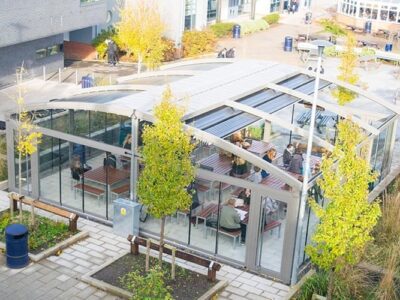
The ultimate guide to school dining canopies: solving lunchtime capacity issues
Posted on | Posted in Education
If you’re a school leader, chaotic lunchtimes are probably a familiar problem. You’re not alone – dining space is one of the most common challenges schools face, and it gets worse when pupil numbers rise but buildings don’t grow with them.
It’s not just an inconvenience when pupils can’t find seats at lunchtime. Queues block up corridors and cause delays and safety issues for everyone. It affects teaching time when students turn up late to afternoon lessons because lunch overruns, it creates extra work for staff managing supervision and it also means some pupils aren’t getting a proper break.
In this guide, we’re covering the practical ways to solve your lunchtime capacity issues – what other schools have done about it, the options that exist and what you’ll need to think about if you’re planning a school dining canopy. We’ve been working with schools for over 30 years, so we’ve seen most of these situations before.
Request a free site survey to get started on improving your space
Contents
- Why dining capacity matters more than ever
- Your options for creating more dining space
- Your canopy options
- How outdoor dining canopies solve the problem
- Real solutions from real schools
- What to consider when planning your dining space
- Funding your dining space canopy
- Getting started
- Frequently asked questions
Why dining capacity matters more than ever
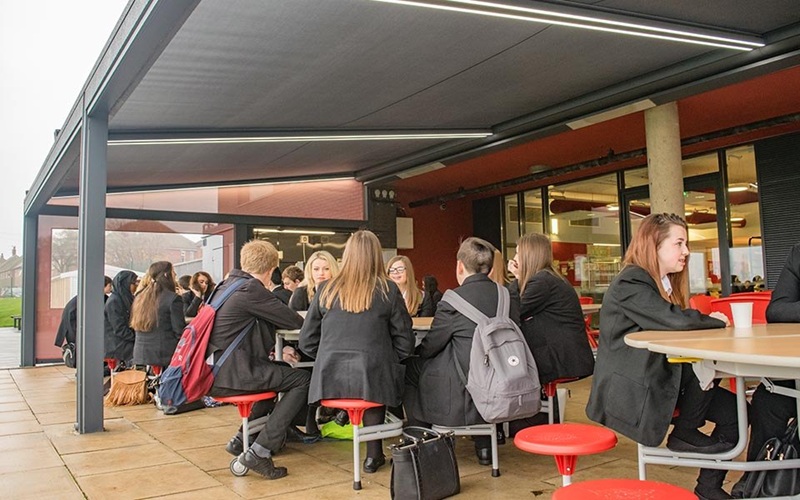
Dining capacity continues to be a challenge for schools up and down the UK. The problems show up in familiar ways:
- Pupils struggling to find somewhere to sit and eat
- Canteen queues spilling out into corridors
- Students arriving late to afternoon classes because lunch took too long
- Some pupils eating outside in poor weather
- Others skipping lunch entirely or heading off-site
- Extra supervision needed to manage queues and congestion
- More tension when space is tight and everyone’s stressed
Your options for creating more dining space
When dining capacity becomes a problem, most schools look at three main routes.
Building extensions
Extensions are the traditional answer. They’re brick and mortar, and if you’ve got the budget and timeline to make it work, they do a great job of permanently increasing your space.
The reality:
- Cost is typically far higher than for an outdoor canopy covering the same area
- Work can take months rather than days or weeks
- Planning permission is almost always required
- You’re essentially dealing with a building site during construction
- That level of disruption isn’t always practical, especially during term time
When extensions make sense:
- You’re planning for years ahead
- You have available capital in your budget
- You want something that feels like it was always part of the building
- You can afford months of potentially disruptive construction time
Modular buildings
Modular buildings sit somewhere between extensions and canopies. They’re semi-permanent structures that can be installed faster than traditional builds, but they’re still a substantial investment.
- Full planning permission is almost always required
- They offer long-term flexibility and can often be expanded, reconfigured or relocated entirely if needs change
- Work well when you need a completely separate building in a disconnected location
Outdoor dining canopies
This is where most schools we work with end up. Outdoor dining canopies offer practical benefits that suit how most schools actually operate:
Speed and disruption:
- Installed in days or weeks rather than months
- Minimal disruption to your school during installation
- Can often work during term time without affecting your normal routine
Cost:
- Typically less than half the price of extensions for the same coverage
- Better value when you factor in how quickly they’re ready to use
Planning:
- Many school canopies fall under ‘permitted development’ rights, so a full planning application isn’t usually required
- Whether permission is needed depends on criteria like size, location and proximity to boundaries
We cover planning in detail in our school canopy planning and compliance guide.
Your canopy options
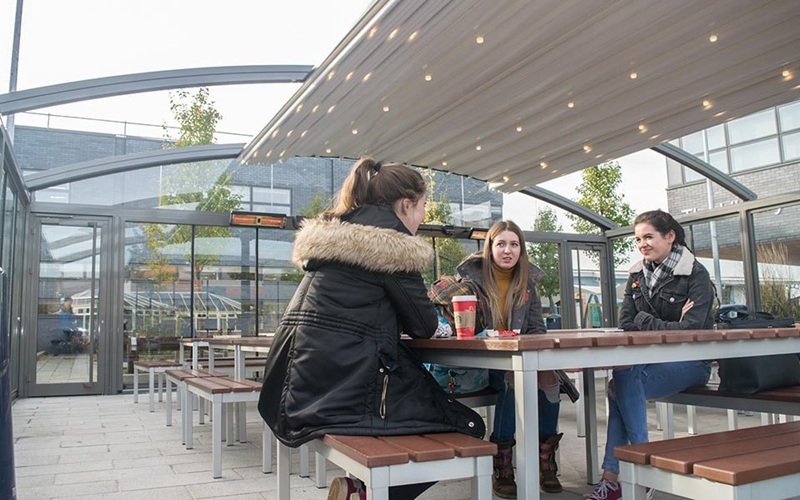
What is a dining canopy and how does in work in practice?
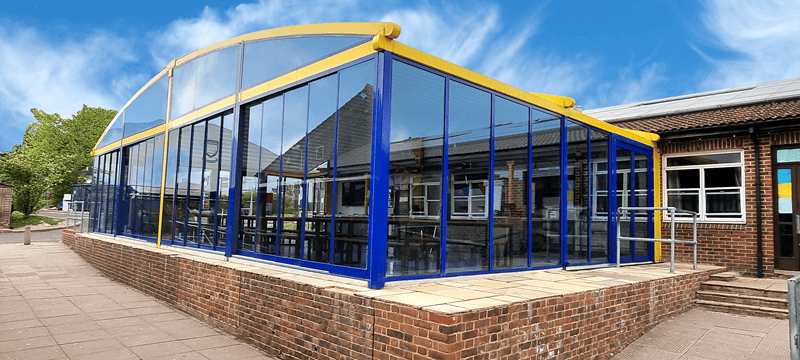
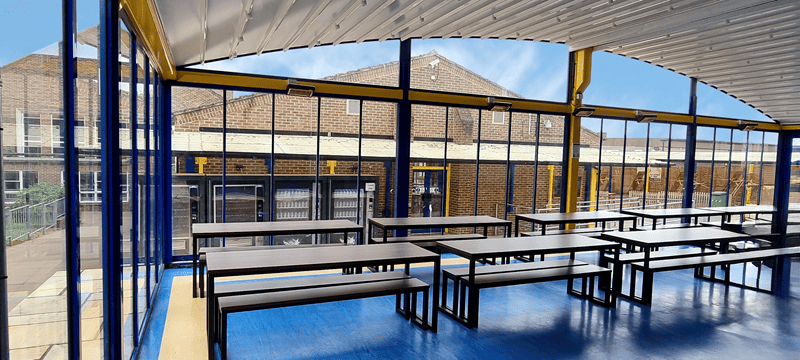
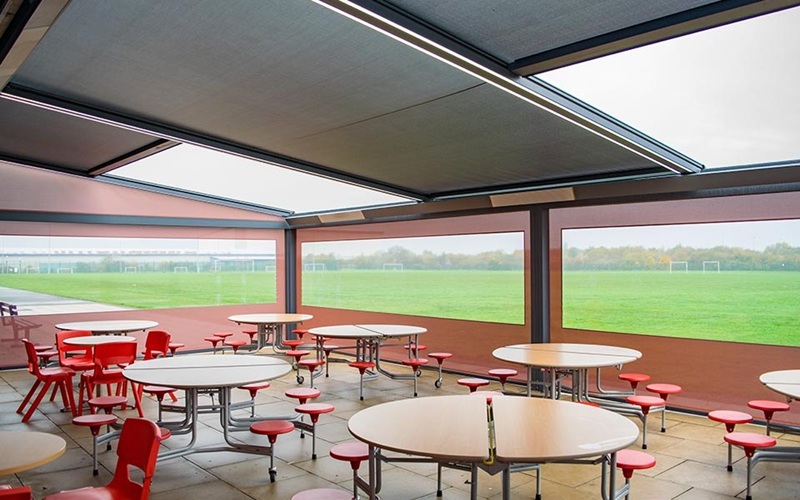
Fully enclosed canopies are weatherproof and work year-round. They feel more like an additional room than an outdoor space, and can even be fitted with heating and lighting. The premium options come with features like a retractable roof that you can open up in summer and close when the weather turns. These are the closest thing to an extension without actually building one.
Our Cantabria canopy is designed exactly for this. It’s a fully enclosed space with a motorised retractable roof, glass sides and options for heating and lighting. It’s the system schools choose when they want something that feels like a proper extension.
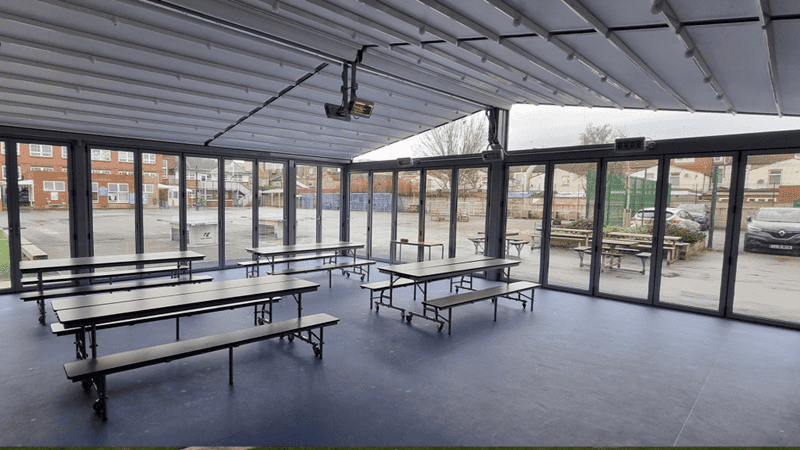
Canopies with sides give you practical weather protection and security. They’re enclosed with panels and doors, they’re durable and low-maintenance and they work in all weathers. This is the option a lot of schools go for when they want a dedicated, fully sheltered dining space that’s going to be used year-round.
Our Connekt system can be configured with side panels and doors to create enclosed dining spaces. It’s modular, so you can start with what you need and expand later if your requirements change.
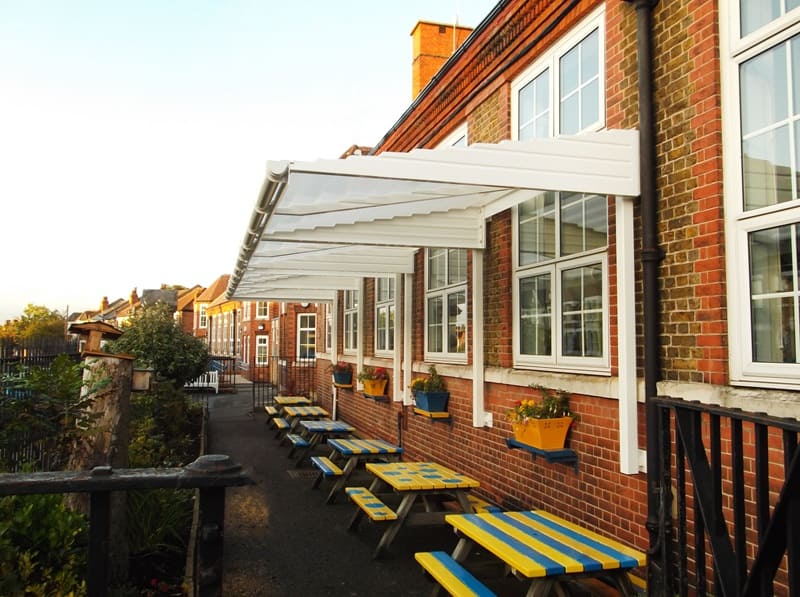
Open-sided canopies provide shelter from rain and are best suited to fair weather use. They work well for overflow dining when your main hall is full, or as multi-purpose space that gets used throughout the day. They’re the most affordable option and the quickest to install.
The Connekt canopy system also works brilliantly as an open-sided shelter, whether wall-mounted, freestanding or in our umbrella-style configuration. It’s flexible enough to suit a lot of different sites and budgets.
See more about our outdoor dining canopies and find out which system would work best for your school.
How outdoor dining canopies solve the problem
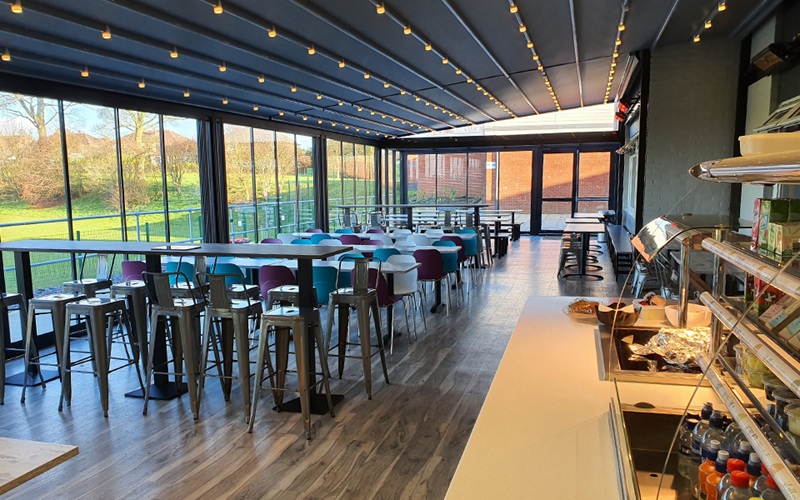
You know the options available, but what difference does a canopy actually make once it’s installed? The obvious benefit is more dining capacity. But, schools that install canopies often tell us they end up using the space for more than they originally planned.
The difference a canopy makes
Ease lunchtime pressure immediately
- Extra seating means pupils can actually sit down to eat
- Queues move faster when there’s somewhere for people to go once they’ve been served
- Staff aren’t spending break times managing congestion
- Pupils aren’t turning up late to afternoon lessons because lunch overran
It’s simple – when you’ve got enough space for everyone to sit comfortably, lunchtime works better.
Create comfortable space in all weathers
Enclosed canopies work hard all year-round:
- Canopies with sides keep out wind and rain
- Add heating and they’re comfortable even in winter
- Glass-sided systems let natural light in, so they don’t feel dark or enclosed
- Systems with retractable roofs give you the best of both worlds – open them up on sunny days, close them when it’s cold or wet
Open-sided canopies are great for overflow dining in spring and summer, or as shelter during break times when it’s drizzling but not freezing. They won’t replace your main dining hall in January, but they take pressure off during the warmer months and give students somewhere dry and sheltered to gather during the rest of the year.
Use the space beyond lunchtimes
This is where most schools find their investment really pays off. We’ve spoken to schools around the UK who use their canopies for:
- Additional dining space
- Break time shelter
- Outdoor learning
- Study areas during free periods
- After-school clubs
- Meetings
- Parents’ evenings and events
Schools typically choose a canopy for one specific reason, but they always find plenty of other useful ways to make the most of the space once it’s there.
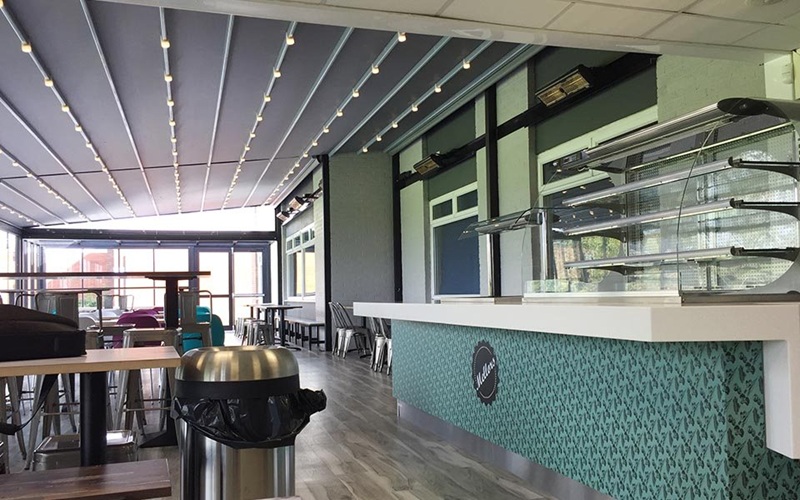
Fast turnaround times
- Installation takes days or weeks, not months
- Minimal disruption – we can often work during term time
- School life carries on pretty much as normal
We’ve completed canopy installations in a week, and we’re used to working around school schedules – whether that means completing everything during term time or timing the work to fit around key dates in your calendar.
Make budgets work harder
- At a much more affordable price than a building extension, canopies help you create the capacity you need without spending capital budget you might not have
- The space gets used for multiple purposes throughout the school week, so you’re getting more value from the investment
- Materials are durable and low-maintenance – systems with lightweight aluminium or durable steel are built to last
- Guarantees included as standard give you peace of mind, and modular systems can be extended if your needs change
When you’re making the case internally for a canopy, the numbers tend to speak for themselves. Calculate the cost per square metre compared to an extension and factor in how quickly you’ll have the space ready to use. Most schools find it’s easier to justify the spend when they can show governors or senior leadership how much extra space they’re gaining for the budget.
Find out more about our outdoor dining canopies
Real solutions from real schools
We’ve been working with schools across the UK for over 30 years, and we’ve installed thousands of canopies. Every school’s different, with different sites, challenges and budgets, but the core problems tend to stay the same: not enough space at breaks and lunchtimes and no room for any activities that happen beyond regular indoor lessons.
Here’s how three schools tackled their space problems.
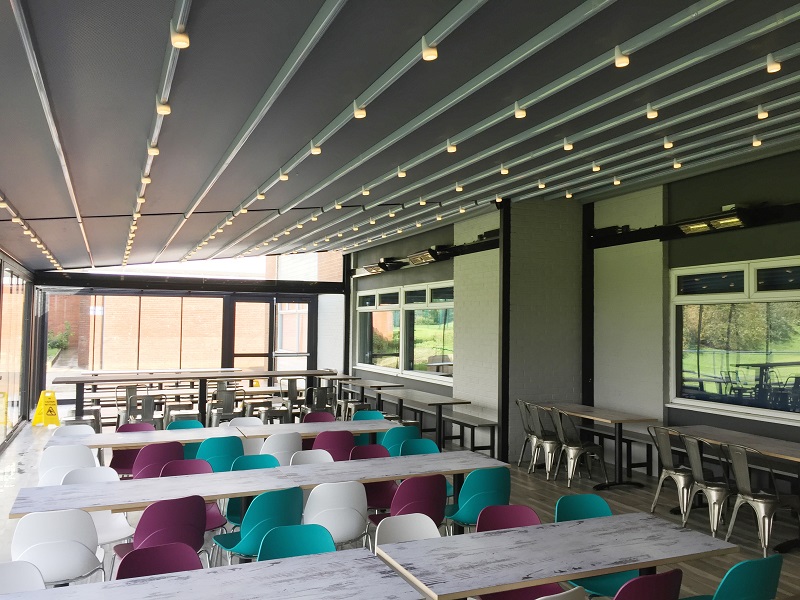
St Michael’s High School, Chorley
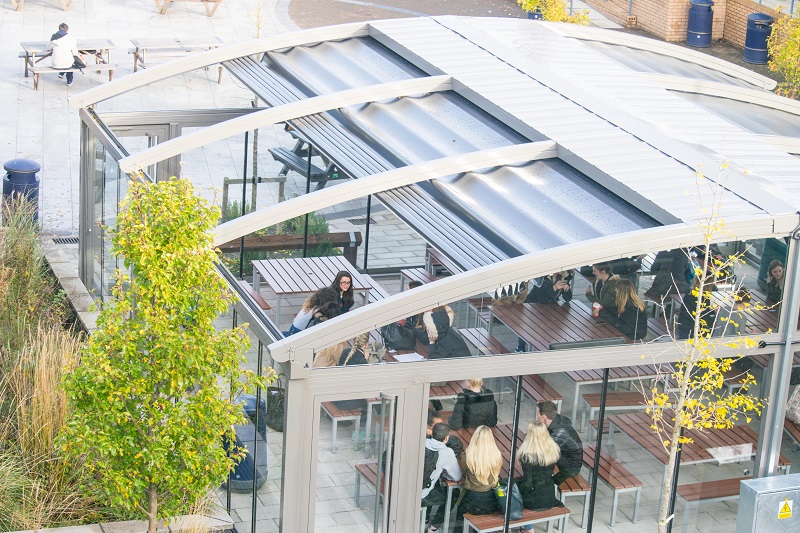
St Michael’s had run out of dining space and were getting quotes for a brick extension. After a site survey, we recommended an enclosed Cantabria canopy instead, with heating, lighting and glass sides that slide open in good weather.
The installation took one week. They got fully enclosed dining space that works year-round, stayed within budget and solved both their dining capacity problem and their lack of general seating space. St Michael’s described it as the best of both worlds between a brick extension and a generic canopy.
Winstanley College, Wigan
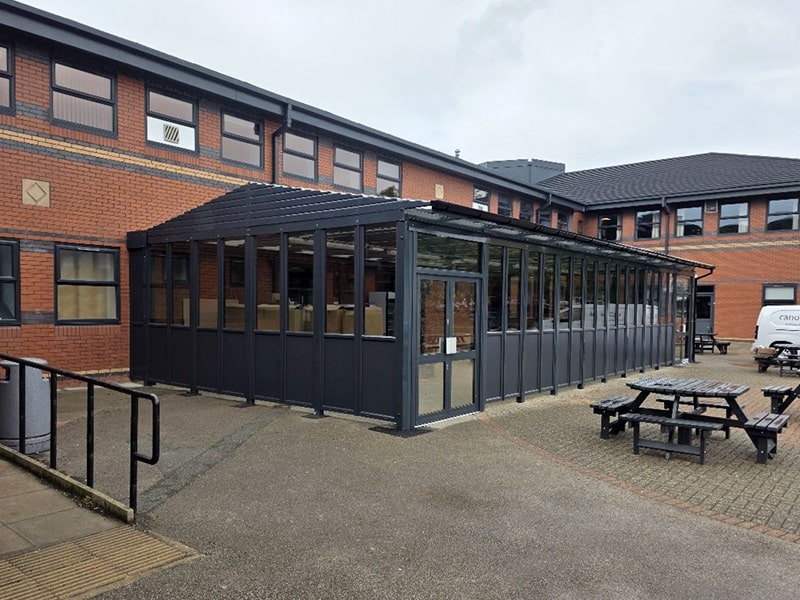
Winstanley is a sixth form college with over 1,300 students. The existing dining hall couldn’t cope with demand, so the college wanted a new, multi-purpose room students could use during free periods. Caterlink, who’d just won the catering contract, worked with us to find a solution.
We installed an enclosed Cantabria canopy with a retractable roof, glass screens that slide open, LED lighting and electric heating. The site had a drop in the ground, so we had to level the area and lay a concrete foundation before installation.
The canopy has become a much-used, versatile space. The school now calls it the “Garden Room” and uses it for dining, studying and events like parents’ evenings.
Standish High School (with Midshire Catering)
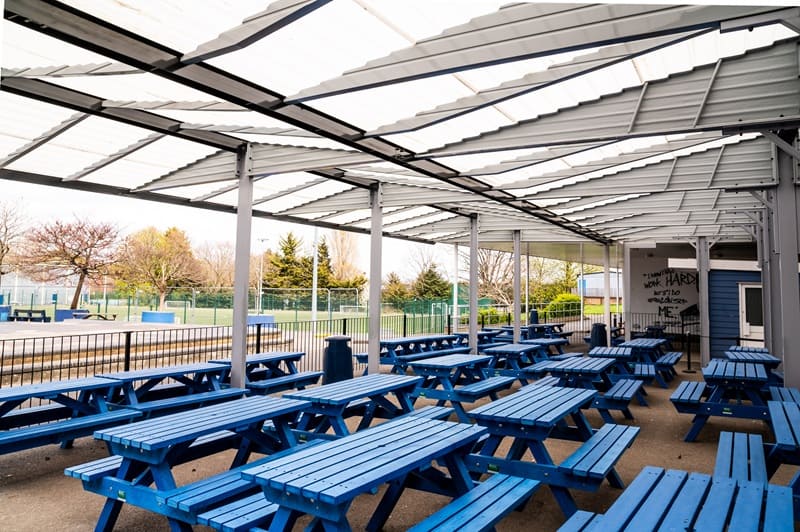
The dining hall at Standish High School was overcrowded and lunchtimes were becoming difficult to manage. Midshire Catering saw an opportunity – as part of their bid for the school’s catering contract, they proposed funding an enclosed canopy.
The deadline was tight, with everything needing finishing before pupils returned for the new school year in September. Because it was an enclosed system, we worked in two stages: main frame first, then panels and doors.
The canopy’s been used every day since its installation. The school got the extra capacity they needed without upfront capital, Midshire delivered a tangible improvement from day one and lunchtimes work better for everyone.
We’ve worked with hundreds of schools, from small primaries to large sixth form colleges. We take on everything from straightforward installations to complex sites with complex ground conditions or tight deadlines. While dining is often the starting point, a lot of schools use their canopies for outdoor learning, events and activities too.
See more school canopy case studies
What to consider when planning your dining space
Once you’ve decided a canopy makes sense, the next step is working out exactly what you need. Every school’s different, so there’s no one-size-fits-all answer, but asking the right questions early on helps you get a space that actually works for your site.
Here are the key things worth thinking about before you start:
Capacity and layout
Questions to ask:
- How many pupils need to eat at once?
- Do you run staggered lunch sittings or does everyone eat at the same time?
- Will you serve food in the new area, or is it just for seating?
- Do you want traditional dining tables or something more flexible?
- How will pupils move between the serving area and the seating?
- Can staff supervise the whole space easily?
The answers affect how much space you actually need and how the area should be laid out.
Location and site
Think about proximity to your existing facilities. How close will the canopy be to your dining hall or kitchen? If pupils have to walk too far with trays of food, it could create problems. And if the canopy is completely disconnected from your main facilities, it might not get used as much as you’d hoped.
Most sites are ready to go as they are. Occasionally, a site needs preparation – at Winstanley College the ground had a drop that needed levelling, and at St Michael’s High School, uneven tarmac meant we needed to lay a smooth concrete base first. We factor this into the timeline and handle the preparation work as part of the project.
Every canopy we install is backed by site-specific calculations tailored to your school and covering wind loads, snow loads, ground conditions and drainage. We include this as standard in every project – it’s key to safety and making sure your canopy performs for years to come.
Find out more: Site-specific calculations: an explainer guide
Planning and compliance
Whether you need planning permission depends on things like the size of the canopy, where it sits on your site, and how close it is to boundaries. Many school canopies fall under permitted development rights and don’t need full planning permission, but it’s not guaranteed.
We cover all of this in detail in our school canopy finance, planning and compliance guide, including timelines, what’s involved and how to work out if you’ll need permission.
The short version: we’ll assess it during your free site survey and let you know where you stand.
Book a free site survey today
Funding your dining space canopy
There are a few ways schools typically fund canopies, depending on what’s available to you.
Capital budget
If you’ve got capital budget available, this is the most straightforward option. The cost is considerably less than a building extension, so your budget stretches further.
Finance options
If capital isn’t available, finance plans let you spread the cost over time. We work with schools on this regularly and can talk you through what’s available during your site survey.
For full details on how finance works and how to access it, see our school canopy finance guide
Grant funding
Various education grants can help with projects like canopies. They change regularly, so it’s worth checking what’s currently available. Some schools also fundraise through their PTA, especially if the space will benefit the wider school community beyond just dining.
Contract caterer partnerships
Here’s something we’re seeing more often: contract caterers funding the canopy as part of their school contracts.
It makes sense for everyone:
- The caterer gets a better working environment and something that sets them apart when bidding for contracts
- More pupils eat on-site because there’s actually somewhere comfortable to sit
- The school gets the dining space without finding capital budget upfront
We’ve worked with caterers like Midshire and Caterlink on arrangements like this, so if you’re working with a contract caterer or about to go out to tender, it’s worth asking whether they’d consider it. For them it’s a long-term partnership investment, and for you it’s a way to get the space you need without upfront spend.
Learn more about school canopy finance options
Getting started
If you’re thinking a canopy could work for your school, here’s what the process looks like.
The process from survey to installation
- Free site survey
We’ll come to your school, look at your space, and talk through what you need. There’s no obligation – it’s a chance to see what’s possible, discuss the options that would work for your site and get a clear idea of cost and timeline.
We’ve done thousands of installations, so we’ve dealt with tricky ground conditions, tight deadlines and budget constraints. We’ll talk through what’s realistic and what would work best for you.
- Design and planning
Once you’ve decided to go ahead, we’ll design the canopy to fit your site and your needs. If planning permission is required, we’ll support you through that. We’ll also plan the timeline around your school calendar – a lot of schools want installations done during holidays or completed before term starts, but we’ve completed plenty of hassle-free term time installations too.
- Installation
Installation typically takes days or weeks depending on the system. We’ll plan the timeline around your school calendar to make sure everything’s ready when you need it.
Our installation teams are DBS checked and experienced in working around schools. If any ground preparation is needed, we’ll explain what’s involved before we start. You’ll have a clear point of contact throughout and once it’s complete we’ll do comprehensive safety checks and walk you through how to use and maintain your new space.
Learn more in our complete guide to school canopies, from planning to installation
- What to have ready
It helps if you’ve got a rough idea of:
- How many pupils you need to seat
- Where you’re thinking the canopy might go
- Your budget parameters
- When you’d ideally want it finished
You don’t need exact answers to any of this. The site survey is where we work through the details together and figure out what makes sense.
Frequently asked questions
Do we need planning permission for a school dining canopy?
Many school canopies fall under permitted development and don’t need full planning permission. It depends on size, location and proximity to boundaries. We’ll assess this during your site survey.
How long does installation take?
Typically days to weeks, depending on the system. The timeline depends on the size and complexity of the project. We’ll plan around your school calendar to avoid disruption.
Can you install during term time?
Yes. Because we’re working on an outdoor structure, there’s minimal disruption to school life. Term-time installation works well and means you can start using the space sooner.
What size canopy do we need?
It depends on how many pupils eat at once and your table layout. We’ll calculate the exact size you need during your site survey based on your lunch sittings and how you want to use the space.
How durable are the materials?
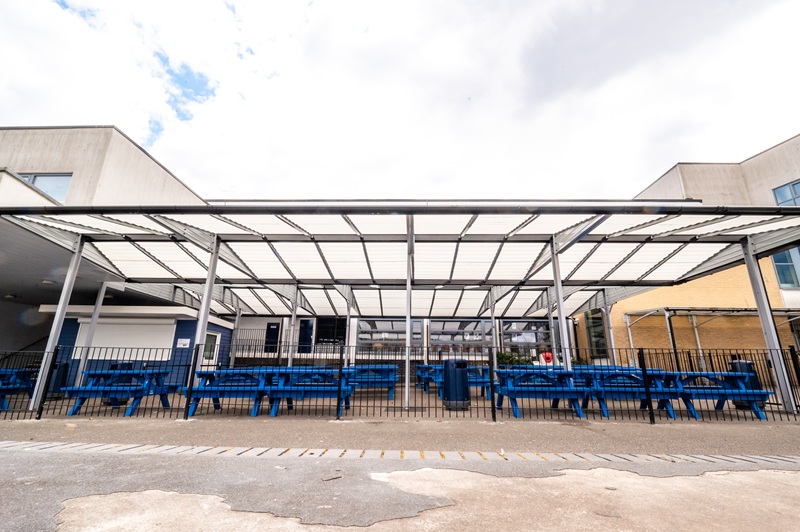
Our canopies use galvanised steel or powder-coated aluminium frames with UV-protective polycarbonate or glass roofing. All components are designed to withstand British weather with minimal maintenance, and every system comes with guarantees as standard.
What about heating and energy use?
Enclosed canopies can be fitted with efficient electric heating. Running costs depend on size and usage – we’ll explain options during your survey.
What warranty and aftercare do you provide?
All our canopy systems come with a 10-year installation and labour guarantee. Product guarantees vary from 5 years to 10 years depending on the system. We provide full maintenance guidance after installation and ongoing support if you need it.
Can a contract caterer fund the canopy?
Yes. We’ve worked with contract caterers who fund canopies as part of winning or renewing school catering contracts. If you’re working with a caterer or going out to tender, it’s worth discussing this as an option.
How does the cost compare to a building extension?
Canopies typically cost less than half the price of a brick extension for the same coverage and are installed much faster. We’ll provide a detailed quote after your site survey so you can compare the cost per square metre.
Ready to create dining space that solves your lunchtime capacity issues and works all year round?
Request a free site survey to see what’s possible for your school. We’ll handle the measurements, planning and recommendations, and our team is always available to answer any questions – just get in touch.